 Picture credit: Annie Zhao
In the front of the musty camp cabin, Jonathan, a bespectacled senior with a soft-spoken voice, reads off of a list on his phone. “Martin and Ryan; Philip and Xiaoteng.” Ten of us guys are circled around him, bundled up in sweaters and rain boots—even though it’s only September, the hours after midnight can become surprisingly frigid. “Uhm, David and William.” As Jonathan reads off each pair of names, the upperclassmen exchange knowing glances. They know what’s about to happen, even though the juniors are in the dark.
“Brian, you’re with, well, other Brian.” The taller Brian punches the shorter one on the shoulder, jostling the entire group. A snicker ruffles through our small group of boys.
“And Michael—you’re with Jonah.” I’m a little relieved. Jonah Zhang seems to be one of the gentler guides. We’re both technically the same age, but he’s been in Asian Christian Fellowship for longer than I have, making him a senior of sorts. He’s wearing his trademark Student Technology Services hoodie and a goofy smile on his face; when he walks towards me, he’s a little uncertain, awkward. It puts me at ease.
“We’ve said this to the first watch already, but I’m saying it again just to be safe. Make sure you’re bundled up, because the woods are always colder than you think. You may not have noticed this, but it’s dark as hell, so watch your step. Don’t want anyone falling in the lake. And pairs, always stick together—coyote watching can be dangerous.”
Jonathan swings open the door, and frigid air rushes in.
The ten of us leave into the woods.
•
No one tells you how lonely freshman year is until you experience the loneliness for yourself. And, just like in faith, everyone’s moment of epiphany comes in different forms. Mine came suddenly, on a late Wednesday evening, when my face was hovering three inches away from the chemistry lecture on my laptop screen. With a cheap cafeteria chicken tender in my left hand, and a note-taking pencil in my right, my eyes suddenly glazed over—I realized I’d been doing the same routine four nights in a row. For four days, I had shut myself in my room right after classes, watched lectures and Netflix until my eyes glazed over, and let my head crash against my pillow to go to sleep. Four days in a row; half a week, a prison sentence, an eternity. The realization was devastating in its simplicity—it wasn’t that studying left me with no time to do anything else. There was just nothing else to do.
My family’s incessant calls only served to accentuate my loneliness. In our weekly group Facetime call, my mother asked: “Have you met any Asian friends yet?” And my grandfather chimed in: “Maybe even an Asian girlfriend?” Laughter from all parties in the call; laughter from Illinois, Pennsylvania, the Philippines. “Y-yeah! I’ve met a lot.” Improvising, I added: “I’ve, uh, even met some Filipino friends.”
This was the right answer. The three faces on my screen smiled, impressed. My mother piped up excitedly. “You know Cielo, don’t you, Michael? Your cousin! She joined the, ano, the Filipino Student Association at SLU. Fifty Filipinos! They have banquets and even dance the Tinikling. You should find those! Asian, Filipino student groups.”
Throughout all of this, I nodded enthusiastically. “Uh-huh. Yeah. Uhm, I wish I could talk more, but I really have to study. A big test tomorrow.” These words, although sudden, were the easy way out—there was no way Asian parents would argue with the filial obligation of studying. “Oh, okay!” We said our goodbyes.
My father: “Study hard.”
My grandmother: “Are you eating well? Eat more.”
My mother: “And sleep early.” They all waved to me, and the screen shut off.
The last thing I saw before the call cut was my mother’s smiling face.
•
The night is clear, but the shade of the tall trees and the mist covering the ground keep anything from coming into view. I’m shivering to my bones—my light sweater is totally unsuited for a night in the woods. I stare at the back of Jonah’s hoodie as he walks; there’s no trace of his earlier awkwardness. He moves determinedly, and I have to hurry to keep up with him on the winding hiking paths. I want to make conversation, make a benign comment about how cold it is, but the other four pairs of guys are hushed in a reverent silence. I swallow my apprehension and continue on.
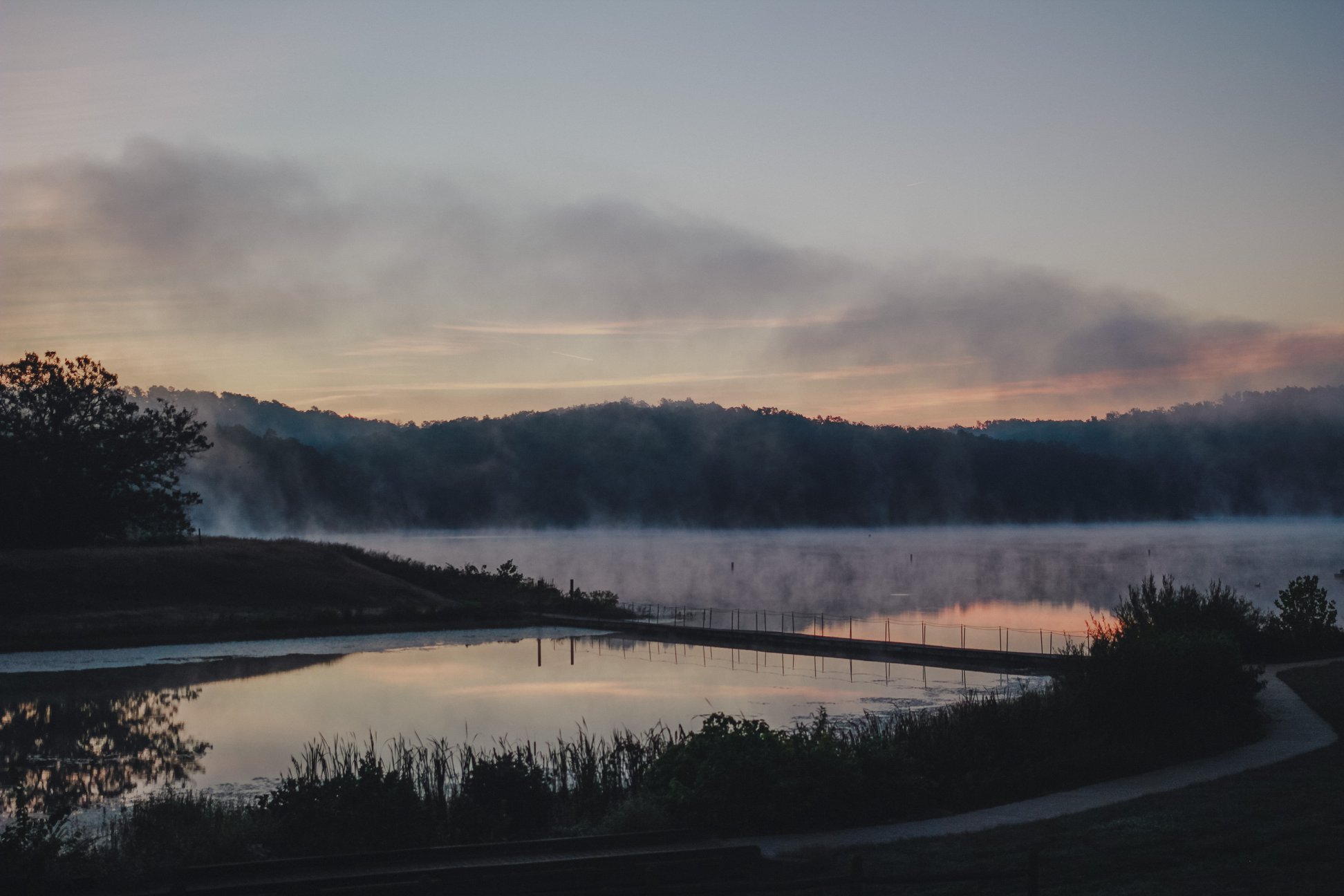
We suddenly emerge from the woods, and in front of us a river unfolds; a fine mist hovers over it, and its reflection glows beneath the night sky. Down by the riverbank, a short distance away, I see a rickety wooden bridge floating on the river, connect our side to the grassy clearing on the other. I’m still shivering from the cold as Jonah begins leading me towards the bridge.
“You’ve probably figured this out by now, but we’re not actually watching any coyotes,” he says candidly, breaking the silence. “We call it ‘coyote watching,’ but it’s a tradition that ACF guys always do for their brothers on the last night of the retreat. I think the girls have a similar tradition. And, oh—watch your step. The bridge is slippery.” I follow Jonah down the bridge, closer to the far riverbank, and suddenly he sits down. He pats the spot next to him. “Have a seat,” he says. “I’m going to take off your socks.”
In the next moment, I’m feeling the cold air assaulting my bare toes, and I start to shiver even more intensely. I’m appalled; turning around, I see the other guys doing the exact same thing, seated and spaced evenly around the bridge. All the underclassmen (myself included) are hovering our feet above the water, while the seniors gingerly peel their shoes and socks off. In the darkness, I see one of the seniors reach down, dip his hands in the water, and begin scrubbing his junior’s foot.
“No. No way. You don’t have to do something like that…” I trail off.
“No, I’m going to,” he says simply, as if it’s already been decided. Jonah’s procured a rag out of nowhere, and he’s bending over, soaking it in the cold lake water.
Indignantly, I protest. “Washing my feet? Jonah—you’re really going to wash my feet?” I look around, and I seem to be the only one protesting. I drop my voice, a little ashamed.
“It’s not as cold as you think. You get used to it.”
His hands meet me, and my entire body shivers.
•
Of course, I had been lying to my parents. It had been five months in college and I didn’t have any Asian friends to show for it. My original strategy of making friends, waiting for someone to magically appear and begin talking to me, wasn’t working, as evidenced by my long nights isolated in my room. So I started to follow my mother’s idea of finding Asian student groups.
Asian kids tend to stick together, and if you wanted to find the big Asian cliques at WashU, you really only had two choices—the international students (I was not an international student), and the Asian Christian Fellowship.
I once heard someone call ACF the “big daddy of all Asian student groups,” and indeed it was—its membership encompassed the presidents of the school’s Lunar New Year Festival, the North Korean awareness club, the K-pop dance team, and every Asian cultural club in between. Participating in its events were members of the Chinese, Taiwanese, Vietnamese, Japanese, Korean, Hong Kong, and Southeast Asian student groups. And, just like the name implied, it was filled to the brim with over a hundred Asian-American Christians.
It didn’t really matter to me whether my friends were Asian or Christian or not, but the prospect of being less lonely while making my parents proud was irresistible. I went starry-eyed thinking about ACF, imagining myself surrounded by other smiling Asian college students, with their arms around me as we posed for pictures. ACF was the portal to my new life, to being part of culture clubs like Cielo at SLU, to performing in Lunar New Year Festival, and to parties and kickbacks and late-night trips to McDonalds.
And so when an acquaintance from ACF invited me to attend their Fall Conference—a three-day Christian retreat in the backwoods of Missouri—I said yes.
•
“Do you know why we do this?” Jonah asks. I shake my head no. He scoops up another dollop of frigid lake water and pours it over my toes. I’m still shivering; a breeze is passing through, and I haven’t gotten used to the cold yet.
“Before he was about to be killed, Jesus gathered his apostles for the Last Supper, right? And up until his death, his role was always the teacher, the leader—the one who set examples, performed miracles, and all that sort of thing,” he explains, massaging the wet rag into the soles of my feet.
“But before the Supper, he goes out of his way to wash the apostle’s feet—something a servant usually does for their master’s guests. Never the other way around. Jesus was trying to say that even the masters will have to serve as servants.”
Throughout all of this, and despite my freezing feet, I nod attentively. I’ve heard this story countless times before, from years of Catholic elementary school—the weekly church services, uncomfortable school uniforms, and school plays celebrating Jesus burned the Bible into my memories. And, of course, I had heard it even earlier from my religious family (over ninety-eight percent of Filipinos are Christian). Jesus washes his apostles’ feet, dies on the cross, and then he rises again to save us from our sins—this was the central story of Christianity, a story that I had to be familiar with if I was going to fit in with ACF.
Jonah gently cradles my foot, and submerges it into the murky water below. “We wash your feet because we—your upperclassmen—want to be your servants in God. And we’ve made a promise to walk alongside you as you explore your faith deeper, to find what you need to find.”
What I need to find? I work up the nerve to speak. “What have you found?”
Jonah finally removes his hands from my feet and breathes a contented sigh. “God’s love,” he says. “A perfect love. To me, it’s the reason for existing.” He looks at me expectantly—is he expecting me to prompt him further? To disagree?
“Other people might have different priorities. But we—we have our eyes on something bigger. This world is beautiful, and there is great value in loving it, but we believe that it can never fully satisfy us. We know that a love even more beautiful, even more perfect, awaits us in the next life.”
My head is spinning. I haven’t been seriously religious since elementary school, when all you had to do to please God was finish your Noah’s Ark coloring book and memorize the rosary. That childlike faith is something I thought I had outgrown; for me, Jesus had taken his place beside the Tooth Fairy long ago. But looking at Jonah, I see a faith I have never seen, beyond familial obligation or halfhearted belief. His is a dedicated, overwhelming love, far more authentic than mine.
So why is Jonah washing my feet, extending this invitation to somebody like me? Doesn’t he know that I came here just to make Asian friends, not for God?
Jonah speaks up, and his brown eyes meet mine. Softly he smiles.
“And God’s love is something you can find, too.”
•
My first night at ACF’s Fall Conference was the happiest I had felt in a long time. On the way to the camp, I awkwardly introduced myself to the other members in the car, each of us crammed in with duffel bags and overstuffed backpacks. (ACF had around nine or ten cars going to camp, all just as stuffed as ours.) The chummy junior next to me introduced himself as Ryan, and threw an arm around me: “Good to have you, Michael! I hope you don’t mind Taylor Swift, because that’s all Lucy plays in her car.” The rest of the car laughed; Lucy whipped around and smacked him on the knee. “I’ll kick you out of this car,” she threatened, and suddenly, I found myself laughing too. We spent the next hour-and-a-half belting the lyrics to every Taylor Swift song we could think of. I hadn’t sung or smiled that much in a long time—I was afraid I was going to lose my voice.
Once we arrived, night had already fallen. Lucy told us to leave our supplies in the car, and follow her into the main cabin. “We’re a little late for worship, so walk in quietly,” she said in a hushed voice. As our small caravan shuffled into the cabin, I saw a few students setting up instruments—an electric guitar, a keyboard, a drum set—in the front of the room, and scores of ACF members seated in foldable chairs facing the makeshift stage. Just as we seated ourselves in the back row, the lights dimmed and the crowd hushed, with no trace of the rowdy socializing a few seconds before.
The music began to play: a guitar and a piano uncertainly stumbling into their opening chords. Everyone stood up, and I stood up too, afraid to be left out. Someone turned on a projector, and lyrics showed up in big white letters on the screen in front of the room:
“Worthy of every song we could ever sing.”
I watched as a transformation began to settle across the audience. People closed their eyes, took deep breaths, and began swaying to the music. Everyone seemed to know the song except me.
“Worthy of all the praise we could ever bring.”
The voices began to gain confidence, lifted along by the raising chorus. In the darkened room, I could see a sea of faces, some stoic, some smiling wide, some struggling to hold back tears. I felt like I couldn’t join in—I was awestruck by the concert unfolding around me. “We live for you,” the crowd sang in unison. “We live for you.”
The strangest thing about the faces in the crowd was that I recognized them. Peering across the room, I saw Will and Joseph and Simon, three boys from my study group that always pantomimed basketball shots instead of paying attention during review sessions. Here, they pumped their fists; their booming voices made the chorus sound like a national anthem.
To my left stood birdlike, brown-haired Allison clutching her hands close to her heart, fingernails turning white. Her cheeks were flushed, eyes closed, as if expecting a kiss from somebody. But all the while she continued to sing, her quiet voice harmonizing with the rest of the crowd.
And directly behind me was Martin—stoic, emotionless, heavyset Martin of WashU football team fame—with both hands raised to the air and eyes shut tight. “Open up my eyes in wonder,” he bellowed. “Open up my eyes.”
Voice upon voice built upon each other, drowning out the instruments, forming a deafening cacophony of worship. In the darkened room, I could only see outstretched arms, tear-streaked faces; my ears and heart were pounding with the music, singing, sobbing; it was hard for me to breathe. The room, to me, was beating and spinning.
Nearby, a boy collapsed into his seat, his head in his hands, and his body shaking as he sobbed. His friend rushed to his side, wrapping an arm around him, and I heard him say, “Shh, it’s okay. We’re here for you, okay. God is here.”
I began to cry. I was overwhelmed at the depth of their dedication, the outpouring of love they were displaying all at once, all together. I looked wildly around at my classmates, my acquaintances, my brothers and sisters in Christ: how long have you been hiding something like this? Is this what you were thinking about the whole time, during classes, on the ride here, before you go to sleep, when you talk to your parents? Is this what you were holding back?
I wondered desperately whether I could become one of them, too, whether I was worthy of joining in the song. Love, acceptance—they seemed to promise me this, and more, if I sang along with them. Standing in the center of the room, I became indistinguishable from the other sobbing, crying, singing Asian Christians in the Missouri countryside.
I stretched my arm upwards. If I joined in the deafening chorus, would I be able to reach this too? To feel what they were all feeling? To see what they could see? And in spite of myself, I began to sing, through tears: “I will put my trust in you alone,” I choked. “And I will not be shaken.”
•
Jonah is still looking at me expectantly. The worship songs from last night are replaying in my head. Both of my feet are submerged in the water now, and I’m getting used to the cold.
I finally ask: “Where did you… where did you find all of this? Has everyone…” I fumble with my words. “How does every ACF member know how to do this?”
“This? What do you mean?”
I pause. What do I mean? I want to ask how this faith is even possible, what force compels so many voices to sing in harmony, where the spark in Jonah’s eyes comes from.
But I can’t figure out how to word it. I settle on a question: “What brought all of you to ACF?”
“We all started in different places,” he replies. “For me, the fellowship was so similar to my church at home that the transition was very natural. I joined because I needed a group like this.
“But everyone here”—he gestures towards the rest of the bridge, with the other pairs of boys—“we all joined because we want to figure out how to love God, and how to dedicate everything we do to him.” Staring at my feet in the lake, Jonah is almost whispering. I strain to hear his voice over the rustling of the trees.
“It isn’t about where we came from, or how much experience we have, or anything. We join because we’re… broken people. And this is what can save us.”
He looks at me. “If you ever want to learn about what you’ve explored here, why we do this, it would be my joy to do that with you. And don’t think of yourself as inexperienced, or anything; I saw you join in at worship yesterday.”
“Yeah.” I laugh, but inwardly, I’m still not sure what to make of last night. Was that really me—was I the one who burst into song in the cabin, whose voice cried out in desperation? Or was it me who collapsed into my chair, with a stranger dropping by my side to comfort me? Had I bellowed, had I shaken, had I cried? It was all such a blur. All I know is that I had lost my voice.
Jonah pulls a towel from his pockets to dry my feet, and as he does, the bridge jolts and shifts on the water. I am suddenly paranoid, as if someone’s about to burst in and arrest me for faking it, for lying. ACF is supposed to be my chance to find friends, to please my parents, to finally stop watching lectures by myself on Friday nights. Not a place to find some spiritual awakening. Coming here was a mistake. I wasn’t here for the right reasons. I want to grab my shoes and run; how could anyone give what Jonah was asking me for?
But when I look at Jonah, I understand. Seeing the faith glowing in his eyes, I understand why someone would come here, why they would stay, and why “Christian” was in Asian Christian Fellowship in the first place. It is a love of God that brings us here, a blind, reckless belief that floods the senses and satiates the soul. I had caught a glimpse of it last night—it had taken me to a place where I sang with my hands held high, when my soul felt full and complete. Jonah looks at me, and his brown eyes promise eternal life. They say that I have been through enough.
To love God, to dedicate my life to him—was this what I had come here for? Was this what I was meant to find?
“I—I’m sorry. I don’t know what to say,” I admit.
“It’s okay. We don’t have to say anything,” Jonah says. “If you want, we can pray instead?”
“I don’t know how to do that.”
“That’s okay. I’ll just pray for you, then.”
“I don’t know how to, well, have someone pray for me.”
“I can teach you that, too,” he says, clasping his hands in mine. “Close your eyes.”
•
I’m meeting a friend a few months later after Fall Conference, eating cafeteria chicken tenders and catching up, and offhandedly I mention my brief foray into religiosity. Sylvia’s Asian, incidentally—through a series of shared classes, we’ve fallen in to the habit of grabbing meals together.
“Wait—you’re in ACF? I just found out that so many people I know were in it, too! The president of our dance team always talks about it.”
“Was. Or I kind of am. I’m not super active or anything.”
“You know, my parents want me to join.”
“Yeah, same. Mine were thrilled when I told them about it.”
“They want me to find a nice, Korean, Christian man. Can you imagine?” Fiddling with a napkin, Sylvia lowers her voice. “Aren’t they, like, kind of a cult?”
I pause. Part of me resists. The word sounds wrong—it feels like I’d be slapping Jonah in the face, or splashing lake water on him and laughing. You washed my feet, weirdo.
Sylvia backpedals. “Oh, nonono, don’t get me wrong, if you really like it, I don’t want to call it a cult or anything.” She stares down at her fries. “Uhh, I’m sorry. Forget I said anything.”
“It’s okay!” I reassure her. Without thinking: “You’re right. They kind of are.”
“I told you!” We both laugh. From the corner of my eye, I see Jonah leave the cafeteria.
In an instant, we make eye contact, and suddenly I remember: the singing, the washing, his merciful eyes. He’s messaged me every week or so since then, and I’ve either made excuses or ignored them altogether. I feel a surge of guilt, trailing a string of broken promises behind me.
But he is looking at me with so, so much kindness. He smiles. I smile back. And absolved of my sins, I turn away.
•
This piece was written in the spring of 2019 for a creative nonfiction class. Some names and identifying details have been changed to protect the privacy of individuals.
| return | next |
|---|