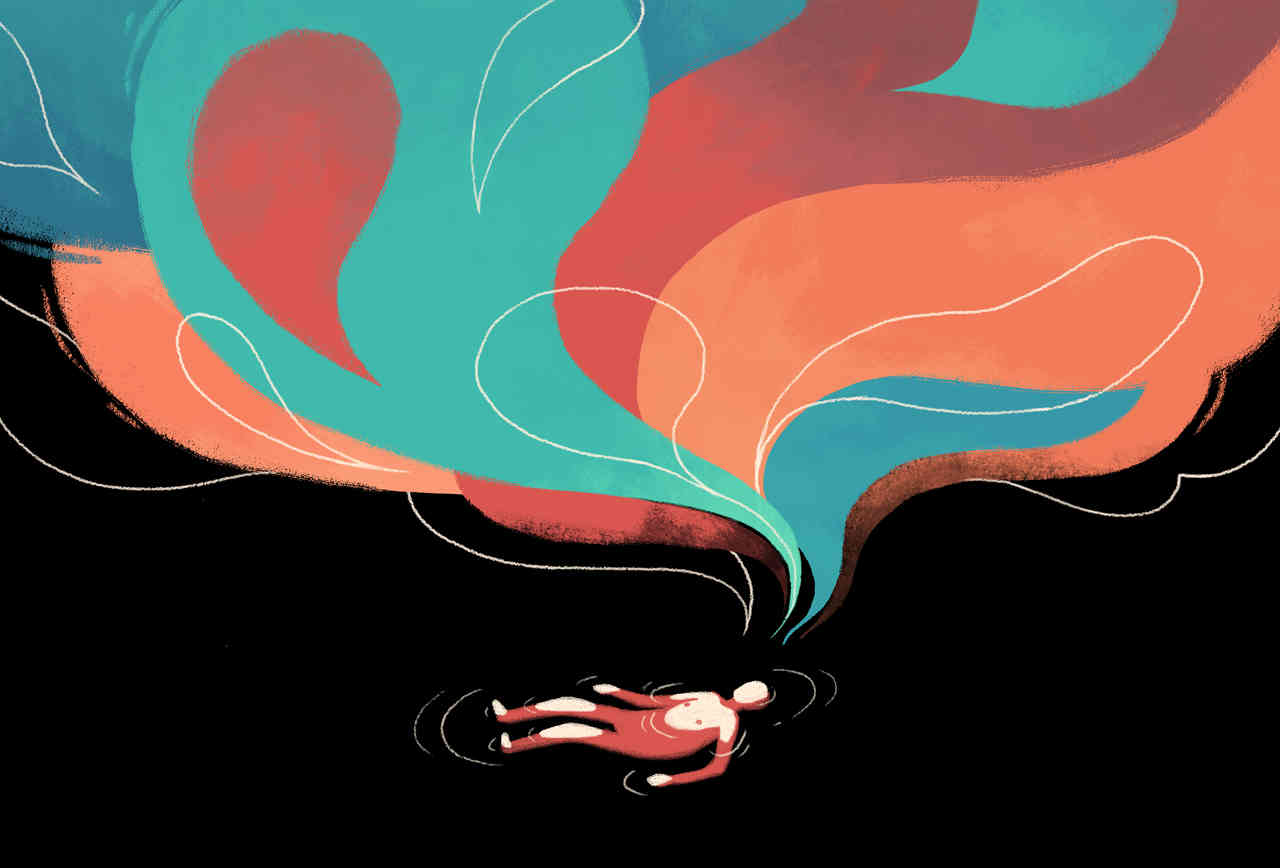
 Picture credit: Cole Ott/Thrillist
Standing naked, wet, and shivering in the darkened room, my thoughts went something like this: “This would be a shitty way to die.”
Turning, I gazed behind me, and the Evolution Float Pod gazed at me back, its dull blue light glowing in the darkness. Sleek and futuristic, the Pod was an enormous, eight-food-long egg that had opened up like a clam; its gaping mouth revealed a glowing pool of mysteriously dense water. “It’s going to eat me,” I thought, and a number of different horror-movie tropes popped into my brain: the water could be filled with some brainwashing chemical; the tank could boil me alive and make me into human soup; or, most simply, after I climbed in, they could lock the tank and never let me out.
But underlying these fears was one that was far stronger, basal, primal: the fear of stepping into the pod, being completely deprived of all sensation—sight, hearing, touch—and left alone with my own roaring thoughts.
Two days earlier, I had made an appointment at Float STL, which, according to Yelp, was the top sensory deprivation spot in the Greater St. Louis Area. Sensory deprivation therapy—nowadays, also known as floatation therapy or “restricted environmental stimulation therapy”—is a process where patients float (naked) in a water-filled tank, devoid of any light or sound. The idea is to shut out all external physical sensations—hearing is blocked by earplugs and the soundproofed float pod, sight by the completely darkened room, and pods are as odorless as can be. And finally, “floaters” can float effortlessly on the salt-water solution, heated to the perfect body temperature—creating an environment where floaters truly feel nothing.
Float STL’s website boasts that it’s hosted over forty-thousand floats since its founding four years ago, and if its plentiful five-star Yelp reviews are any indication, each one of those floats was a transformative experience. “My entire experience was absolutely amazing… my body and mind were so clear it was almost intoxicating,” writes one reviewer. “It makes you feel so rejuvenated,” writes another—“it feels like taking a power washer to your brain.” What was so alluring about Float STL’s sensory deprivation experience? There was really only one way to find out.
Floaters are a diverse group. Steph Curry, legendary point guard and king of threes—visits a float spa monthly with his teammates for the physical benefits: releasing muscle tension, decompressing the spine, and refreshing the body. Physicist Richard Feynman discussed taking “out-of-body” experiences while floating, joining the ranks of engineers who claim it boosts creativity and mental acuity. Stand-up comedian Joe Rogan owns his own Samadhi brand float tank—the most expensive models, costing over $10,000, can convert themselves to couches and back again, like a futuristic pull-out. And practitioners from all walks of life (or, at least, the walks of life able to afford $60 an hour to float) use floating to enter a meditative trance and communicate with a deeper “self.”
So why was I interested in floating? Curiosity, mainly—I realized that, technically, I was always sensing something, and I wanted to know what it would be like to have that constant background noise stripped away. I began searching for someone who had floated, and found out that an acquaintance went into a sensory deprivation tank for that same reason—to have some sort of experience he’d never had before.
•
I met with Lucas, a sophomore from Chicago who’d floated before, on the Tuesday night before my float, and over cups of tea (mine mango, his green), I asked him about why he decided to float in the first place. “At first it was just kind of a curiosity. I thought that somehow, I would have some form of intense experience. It offers something that’s not present all the time.”
At the time of his first (and only) float, Lucas was chasing after new sensory experiences, through substances, music, sex, and relationships. But he tells me he found his float “underwhelming”—the most interesting part of his day was not floating, but leaving the tank. “Seeing and hearing were suddenly very nice. I was like, ‘Wow! I just got hatched out of an egg!’ It was like… a nice, refreshing meditation session had happened.”
In between sips of tea, Lucas explained to me his fascination with meditation—in his thrill-seeking search, no practice was more rewarding to him than meditation. Our conversation, then, kept naturally steering back to meditation: in Lucas’s words, it was his way of “noticing things that you don’t notice normally.”
“I think that whether you’re meditating or in a sensory deprivation tank, if something wants to come up, like some urge or desire or feeling, it will naturally come up. It’s like they’re blobs of emotion or feeling. You know how when you tense a muscle you can feel it? It’s the same with emotions. They’re in the body. And after attention is put on them, they’ll just, pwshhh, dissolve into the air.”
“And you’ll only notice your…” I pause. “Your blobs when you meditate?” Lucas’s abstractions were losing me, but I wanted to know more.
“Yeah. When you do things like that, things that you don’t bring to your attention come to your attention. Once you’re quiet in your mind, your problems can get really loud—and the way I focus on it is by quieting down and letting it happen.”
Going back to my room, I made my decision. I would make an appointment at Float STL, not just to satiate my curiosity, but to see what emotions were waiting to bubble up inside me.
•
Float STL’s modern, baby-blue colored website tried to make their chemical-filled deprivation chamber sound as relaxing as possible, but at the end of the day, it was still a chemical-filled deprivation chamber. Before confirming my online order, I considered my apprehensions. Was I really about to spend fifty dollars and a quarter to get trapped in this capsule for an hour? All alone? Of course not. So I did the logical thing, which was to invite my friends to come along with me.
Sylvia: hello FELLAS
anyone want to be DEPRIVED of their SENSES tomorrow at 3 pm
Ako: sylvia what
Me: ok more info: im going to a sensory deprivation place tomorrow at 3pm because im gonna write about it for creative nonfiction
its wild! basically u float in a pod filled with salt water and soft lighting for an hr
Michelle: Omg!!!
That sounds cool
Also sounds like baptism
Sylvia: just a note it’s a lil pricy but I’ll do it for the Experience am I right ladies
Ako: omg im down
ill skip social psych for it
Sylvia: but was also thinking if we all go an uber is about four or five bucks a person?
Michelle: I just booked!!!!
Ako: me too
signed the waiver
omg ok
this is wild
And from the one friend who couldn’t make it:
Justyn: I hope your senses are deprived hella hard In a good way
•
Humans evolved the sense of hearing in order to avoid the calls of predators, to hear the rush of fresh water, and to communicate with our fellow man. We learned sight to detect threats from far away, identify which plants were food and which were poison, and to make our way towards the light and away from the darkness. And touch is the most ancient sense, used for billions of years to feel the world around us.
In other words, we must use our senses to survive, a fact known since antiquity, when Aristotle wrote that “to destroy the capacity to touch is to destroy the very animal.”
And yet, scientists in the 1950s, armed with new brain-imaging technologies, neuroscientists began to wonder what would happen to the brain in the absence of the physical stimuli we need to survive.
Dr. John Lilly, a somewhat controversial figure in the 1950s world of neuroscience (near the end of his life, he claimed he could communicate with dolphins), explored devices that could deprive the senses, and developed a seawater tank where subjects could float. His goal was to “reduce the absolute intensity of all physical stimuli to the lowest possible level”—the tank could even remove the sense of gravity. In those days, it was common for scientists to use themselves as subjects, and Lilly was delighted to find that he experienced deep relaxation and meditation within his tank. Realizing the benefits, he began to improve his tank design further—for consumers rather than scientists—and the field of sensory deprivation therapy was born.
As the sensory deprivation trend gained momentum, modern neuroscientists brought Lilly’s tanks back into the lab to test their benefits. Modern neuroscientists brought Lilly’s tanks back into the lab to test their benefits, and a 2015 study found that practices like floating, meditation, or hallucinogenic drugs switched off a part of the brain called the “default mode network.” It’s a huge network of brain regions that, ironically, is the most active when you’re not thinking about anything—it’s the source of daydreams, the neural center for boredom, and where that urge to stare out the window during class comes from. But switching that network off would disable your ability to get distracted, letting you focus on one thing at a time; as Lucas had said, when he meditates, the problems in your consciousness “bubble up” and fade away.
In other words, floating and meditation provided an antidote to constant mind-wandering. Take away the source of distractions (through sensory deprivation) and the tendency to be distracted (through a meditative state), and you’ve got the perfect formula to probe into the deepest layers of your brain.
What would I see in the true solitude of the tank? I wasn’t sure, and I didn’t even know if it could be described. But in his autobiography, Lilly attempted to convey what he felt after a lifetime of floating regularly in his tanks:
“When I was floating in the silence, darkness, wetness, alone… I called it the Isolation-Solitude-Confinement-Happiness-Freedom-Domain. I found the tank was and is a vast and rich source of new experience.
“One is not deprived, one is rewarded.”
•
Float STL’s spacious lobby was decorated like the hippie’s paradise. Pushing aside a curtain to walk in, Sylvia, Michelle, Ako, and I removed our shoes and took in the scent of burning incense. The floor was carpeted in an array of knit rugs, with yoga mats and exercise balls pushed under a shelf. Off to one side was a curtained-off tent area with pillows on the floor for relaxing, and another corner was stocked with books on chakras, astrology, and sketchbooks for any post-float artistic breakthroughs.
Two men greeted us: Jacob, shorter, sporting a man bun and mustache, and Yonn, taller, lanky, and bearded. Both sported patterned robes over baggy pants, and both spoke with soft yet insistent voices. Jacob was the more talkative of the two, eagerly telling us about floats while Yonn poured us tea.
I asked Jacob if he remembered what his first float was like, and a soft smile grew on his childlike face. “I do,” he said in a low voice. “It was a Samadhi tank in Chicago, and I felt like I was lying on a giant bed of whipped cream, and I was sinking into it, and suddenly I hit this empty bottom and fell through…”
Ako and I gasped.
“And then I went into this weird dream state, where I just saw scenes, like watching a TV show. Not even from my life, just made-up random ones. Coming out of it, I felt like I was reborn.”
I asked, “So you feel reborn every time you float?”
Yonn finally spoke up. “That’s how he stays so young. He’s actually fifty-five.”
Jacob laughed heartily. “Fifty-two! Don’t push it.”
•
Jacob led us on a quick orientation of the float rooms: each was equipped with a rainwater shower, body wash, shampoo, conditioner, towels, and, of course, the enormous capsule-like float pods. The procedure was simple, and diagrammed on a friendly infographic poster: we would put in earplugs, shower, float, shower again, and go back to our lives. The four of us became a chorus of oohs and aahs as Jacob opened and closed the futuristic pods. “It looks like a whale!” Michelle exclaimed, and she was right; I just wasn’t sure whether I was ready to be the biblical Jonah.
All too soon, Jacob had finished, and he turned to me. “Alright, Sunny, you signed up first, so I’ll leave you here, okay?”
“Okay,” I heard myself say, and Jacob led my three friends out of the door. I heard my friends call after me—”Bye! Good luck!”—but their voices were cut off by the slam of the soundproofed door. I was alone, the pod silently whirring behind me.
For the first time since the visit began, I felt terrified. I had this irrational, primal fear that the whale’s gaping mouth was going to leap right off the tile floor and eat me. But I had already come this far—made the appointment, stripped down my clothes, and covered myself in questionable body wash—and I wasn’t going to leave without getting in the pod, dammit.
Jacob had called floating completely effortless— “You just pop up like a cork in water”—and he was right. As I gingerly stepped into the tank, it pushed back towards me like thousands of miniature life jackets. The water was dense and heavy, and waving my arms to splash around in it proved more difficult than I expected. I took a second to stare at my naked body, bathed in the mysterious blue light of the pod, and finally worked up the nerve to pull the tank’s handle shut. The pod closed with a thud, shutting out the light. I let myself body lay limp in the darkness.
•
The first thing I noticed was the movement of the water. Since my body had just recently hit the water, the pool was still ebbing and flowing, enough to bump me into the sides of the circular pod. For the first few minutes, I enjoyed splashing around in the pod, and feeling the strange texture of my body—and then a jolt of fear hit me when I realized I couldn’t move.
Movement of any part of your body involves three distinct signaling pathways: the impulse to move, the body’s reaction, and recognition that you are, in fact, moving. But for me, those three events—which would typically take milliseconds—were becoming uncoupled in time. While the music was playing, I could bring myself to push myself back and forth in the pod, but that ability was quickly eroding in the silence. When I thought about moving my arm, no movement would occur; sometimes, I felt my leg twitch when I didn’t intend it to. Even when I gathered all the energy I could into moving a fingertip, a terrifying three seconds stretched between the thought and the movement.
After all I had read about using pods for creativity, problem-solving, or reflecting on life, I tried to picture scenes from my life, but to my horror, they began to unravel too. It took more and more effort to imagine what I had eaten that day for lunch, or the weather that day, let alone any projects for class. Sylvia’s face, which I had just seen a moment ago, was just a blur of an eye and some hair. Desperate for a mental foothold, I tried picturing my childhood backyard on a sunny day, the red-and-yellow playground in the distance, but all that was left was a sliver of sunlight, a patch of green grass. I was seeing the world through blinds, and those blinds were closing minute by minute.
Lucas was right—thoughts and feelings were bubbling up towards me—but I could barely move a mental muscle to hold on to any of them. Flickers of scenes, snippets of songs, faces of strange men flitted in and out of my head. I couldn’t tell whether I recognized them or not; the ability to recognize anything was slipping through my fingers. Something was coming undone in my brain; I felt bundles of nerves coming unraveled and submerging themselves in the salt water below me. All I could do was sit and watch, and feel, and listen to all of the things flying into me.
Strangely, I wasn’t scared. I knew how much I had lost, but I wasn’t scared. Perhaps the emotion of fear had already spilled out of my head and into the salty neural soup below, but maybe this is the state a mind could inhabit without going insane: lost, floating, adrift. Floating in the water was a state beyond consciousness, beyond perception, where there is no such thing as remembering, and only sense was to sense. There was everything, and then there was a hole in the center of everything, and that hole was my head in that soundproof pod on that Wednesday afternoon.
•
When my time was up in the pod, a relaxing music track began to play, and soft blue lights came on inside the pod. In the latest of several surprises, I woke up fairly easily, and after an experimental movement of my limbs I was able to sit up and haul my salt-water covered body out of the pod.
I was the third of my friends to finish my float time, and I met Ako and Michelle already drying their hair in the lobby. When Sylvia finally emerged, Yonn offered all of us tea, and after hanging out in the lobby for a while, our day in Float STL ended.
During the rest of the day, I found it surprisingly easy to forget about what happened that afternoon. As we said goodbye to Jacob and Yonn, my friends and I talked about the strangeness of the whole thing—how strange our bodies felt (“I felt like my limbs were separated from my body”—Sylvia), what it was like to bump into the sides (“You know that DVD screensaver, where the logo bumps into the sides over and over again?”—Michelle), and just getting bored of the whole experience (“I got up and walked around and played music on my phone for a bit”—Ako). I laughed too, and shared some of my strange paralysis feeling, but it wasn’t until lying in bed that night that I remembered the strange trance of neural emptiness that met me in the pod. It baffled me. How could I have forgotten until now? I should have been paralyzed with fear at the hole in my consciousness, when I lost my handle on my thoughts.
But, in the end, it was only a mere a hole in consciousness, a gap in memory. And the hole was already filling up with the sights and sounds of the world, overwritten by the memories of walking into the sunlight with my friends. I closed my eyes to sleep, and began to dream.
•
This piece was written in the spring of 2019 for a creative nonfiction class. Some names and identifying details have been changed to protect the privacy of individuals.
| previous | return | next |
|---|