In the winter air you laugh and yell and throw your bundled bodies into snowdrifts. “I’ve never seen this much before,” you say, and you really mean it—you’ve never been this far north. “I can’t even see anything,” Angel jokes, with her head facedown in the ground making a snow angel. Your jacket is gray while hers is bright blue, a thermos of tea stuffed in the pocket. Her hair is curly golden-brown and flecked with snowflakes. The snow is white and fluffy and the sky above is white and fluffier still. And although it is cold, your mouth is overflowing with tea and honey and warmth.
•
“If I were you I would’ve seen it coming from a mile away” is what she says when she pulls away from you for the last time. There is the heavy gravel beneath your feet and the darkened sky above your head and you gaze up and you gaze down and realize you can’t tell the difference. Your mouth is hot and sticky and your eyes have already glazed over, and—well, of course I hadn’t seen it coming, is what you want to say. How could you, with the world spinning around your head like this? It’s a miracle you’re able to stay on your feet, you think, but the ground is already swallowing you up and filling you up with sand. You glance at her eyes and she looks away from you. You hear yourself croak, “I’m sorry.”
•
The short version of the story is that Angel ghosts you—cuts off all contact and leaves without a word. It’s the story easily told to other people, since that term, “ghosting,” is so rich in simplicity. Angel was here, and then she wasn’t. You loved each other, and then you stopped. From nowhere to here to nowhere again; an easy zero-sum game.
•
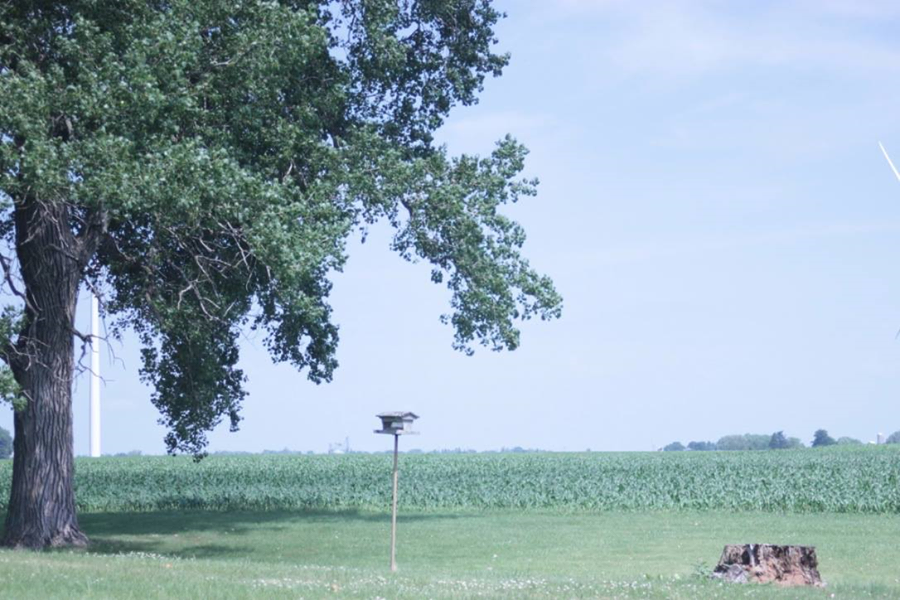
“I really like that color between pink and orange,” Angel says, “the one you see during sunsets.” It really is a nice color. When studying last night you learned that heat, color, electricity, radiation, and light are all the same thing: all manifestations of electromagnetic waves flying at millions of miles per hour. It sounded like a fantasy, then—how could heat from a microwave, the electricity running a cell phone, and the forces in toy magnets be one and the same? But this is not so hard to believe when she shows you the sunset over the grassy field with her hand in yours. The two of you stand in a wide expanse of ankle-high, scratchy grass, flat in all directions, extending infinitely towards the horizon. You close your eyes and feel yourself falling into the endless sky; she pulls your mouth to hers. The feelings—falling, kissing—are one and the same.
•
Shining a light on any chemical with a prism reveals a spectrum of colors called a line spectrum that acts like a unique fingerprint for every chemical. With these fingerprints, scientists can use the light emitted by stars to take the pulse of galaxies. Blue light comes from titanium-filled stars a million times as bright as the sun. Orange means the cold, fading light of a dying star. You wish you could shine a light through her to see the spectra she releases, to identify whether she was glowing or dying, to find the secrets she kept, the molecules separating where she loved you from where she stopped. You want to see it from a mile away. But she absorbed all of it, and you are left blind in the darkness.
•
Holi—the Hindu festival of colors—is in full swing that spring afternoon, and hundreds of students fling colored powdered paint into the air. Holi is a wild free-for-all of water balloons, water guns, and paint—a time to celebrate the end of winter and the beginning of a joyous spring. You dance and sing and scream in a dizzying array of bodies; a friend (or a stranger?) jumps on your back and smears pink paint into your hair. You fight back with a blood-red hit of your own. In the blur of green and blue and orange you lose grip on Angel’s hand, but you don’t need to worry; you know that she’ll come back.
•
Lately when you kiss, Angel’s mouth fills with apologies: I’m sorry for always asking you to meet, that I don’t make you laugh as much as your other friends do, that I freak out sometimes and get scared of losing you. “I’m sorry,” she says, breaking into sobs, “for asking so much of you.” You hold her shaking body close to your chest and close your eyes. It’s too much to see her reddened face, her tears leaking like faucets, and the light refracting off her bloodshot eyes. Light becomes distorted when passing through a transparent medium like water; you wonder if she can even see you through her tear-filled eyes. Her vision must be warped, the image of your face deformed. Nose too big. One ear bigger than the other. Face twisted from sympathy into a sneer. “I need you,” she chokes. “Please don’t leave me.”
•
Before you get a chance to look at her properly, you get to know Angel through her voice. Endless phone calls stretch between the two of you—an electromagnetic tether connecting one cornfield town to another, and converting sound into radio waves, another form of light waves, and back again. Angel’s voice is tossed into the night sky, and returns to you from space half a second later. Heaven-sent.
Angel quivers over the phone. Without warning she lays herself bare: stories pour from her mouth of her fraught family, the boyfriend she never loved, the trees she photographs on the weekends. You feel like the only person in the world who has listened to her like this. In return, you stumble from the banal to the vulnerable: you describe the branches of a tree outside your window, and confess to your loneliness, mental illness, and dissolving friendships.
“Even if you don’t have those friends anymore,” she says, “you’ll always have me.”
It is a hazy spring, and as the trees spill petals onto the sidewalks, Angel promises that she will stay with you.
•
Angel is someone who prays. You are not. She shepherds you into the Catholic church’s chapel just as service is starting, and the sunlight through the stained-glass windows blinds you; your body is bathed in a pale blue. The atrium is spacious, walls covered in portraits and paintings, studded with pointed spires and stone columns. Ahead of you is Angel’s body bathed in golden light and gingerly dipping her fingers into holy water. Hands still wet, she takes your hand and leads you inside.
Angel’s beliefs are a blend of Christian theology and pagan mysticism; she speaks in the vocabulary of souls, covenants, and eternity. She believes in soulmates (you are hers), and makes promise after promise: “I’m staying for a long, long time,” she writes in a note slipped to you during service. You wonder what she sees in the light of the sunlit chapel. In the Bible it is written that “God alone dwells in unapproachable light, whom no man has seen or can see” (1 Timothy 6:16); when you turn your head, Angel is staring straight at you. The cold wooden pew threatens to steal warmth from your body, but she puts your hand in hers. You can still feel holy water. Hers mingles with yours. She is beating, warm, alive.
•
You live life fast now that she is gone—leaving class first, walking home quickly, swallowing meals quickly without having to taste. Without another presence to factor in the calculus of movement, you can cut out any unnecessary gestures, leaving only the swift, clean, and economical. Objects moving close to the speed of light have their natural colors altered in phenomena called redshift and blueshift; green leaves can appear blue, infrared becomes ultraviolet, and soon visible light dissipates entirely. Why did she leave? you wonder. Where did she go? Is she sorry, too? But the answers have already faded. The sun has become too bright for your tired eyes; you sleep, and wish you had remained blind.
•
What color are Angel’s eyes? A question that comes to you late at night, long after she ghosted. The trees are spilling their leaves on the ground in a wanton display of color, but the color of those two pinpricks of light eludes you. The memories are muddied, temporally and spatially; in one instant, her eyes are closed, laughing with you in the snow, and in the next, she averts her eyes as you try to apologize for ignoring her. She is calling out to you from across the street, sandals wet with morning dew, and saying “I’m so glad we’re finally eating breakfast together!” You are calling her late at night, gasping for air as you are wracked with anxiety attacks, and she is not picking up. She was here and she is gone. She is running to you then you are running to her, and around in circles you go.
•
Of course, the memories go on and on. Close your eyes and you can stay here for hours. Here—you stand ankle-deep in tall, scratchy grass. The twigs on the ground snap at the lightest touch; the branches on the dead trees above are just as fragile. There is the pond below, polluted and choked with algae. There is the sunset sky above, streaked with pink and orange. Cover your ears, and you can hear the blackbirds above and the trucks on the nearby highway. Do you remember what the birds were called? Angel taught you, once. It’s okay if you don’t remember. That’s not what’s important. Relax your arms and your legs and now you can feel it all, you are completely here, her body outside and inside yours. Consciousness turned inside-out. Lie catatonic on your bed and let your body rot. Fold your hands in prayer. The dreams are still there.
Their light has not yet faded.
•
This piece was written in the fall of 2019 for a creative nonfiction class. Some names and identifying details have been changed to protect the privacy of individuals.
| previous | return | next |
|---|